Authors: Jiwon Lee1, Hyuk-ju Go1, Eun Byeon1, Yujin Jeong2, Jaeyeop Jeong2, Jiyeon Oh2, Jin-Woo Jeong1,2 Affiliation:1Dept. of Industrial Engineering, 2Dept. of Data Science, Seoul National University of Science and Technology
학회: Korea Software Congress
Venue: Korea Software Congress
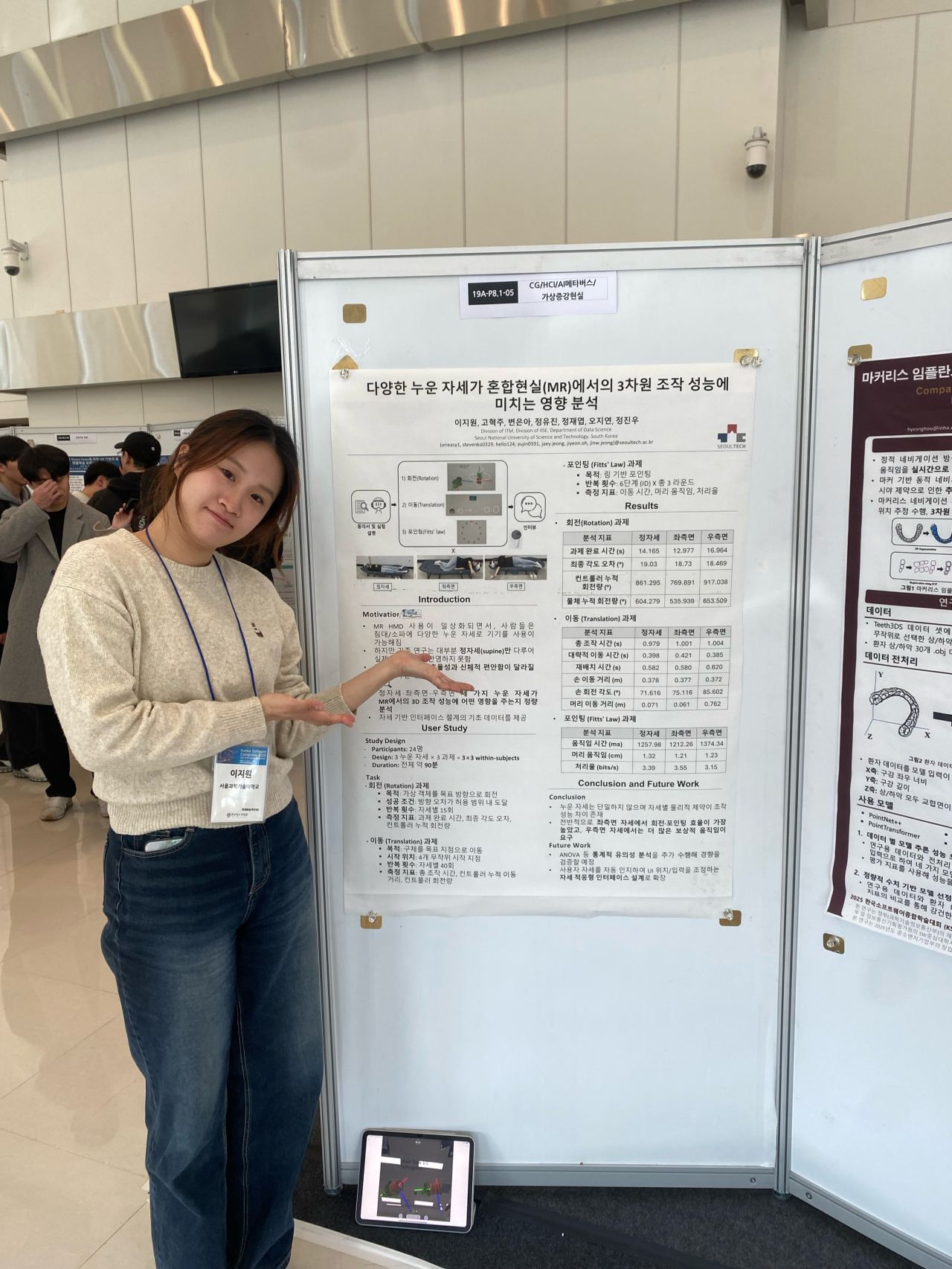
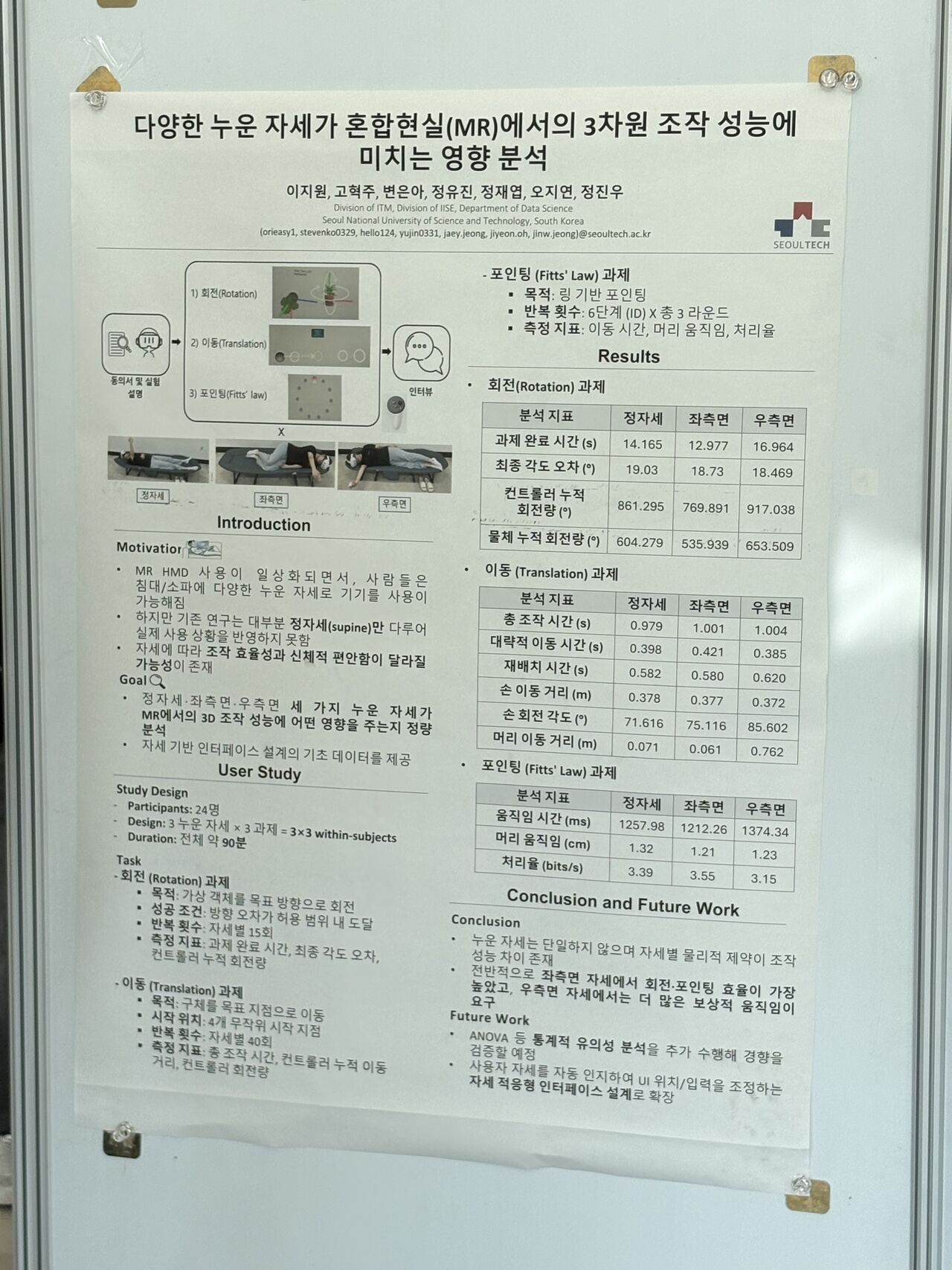
본 연구는 정자세 및 측면 누운 자세에서의 혼합현실(MR) 3차원 조작 성능을 비교 분석하여, 사용자 자세가 기본 조작 과제(Rotation, Translation, Fitts’ Law)에 미치는 영향을 정량적으로 평가한다.
This study quantitatively investigates how different lying-down postures affect 3D manipulation performance in Mixed Reality through fundamental interaction tasks.
컴퓨팅 디바이스의 휴대성과 성능이 발전하면서, 사용자들은 더 이상 책상에 얽매이지 않고 소파나 침대에 눕는 등 다양하고 편안한 자세에서 기기를 사용해 왔다. 혼합환경(MR) HMD(Head Mounted Display) 사용에서 있어서도 사용자들은 자연스럽게 소파나 침대에 눕는 등 기존의 편안한 기기 사용 습관을 그대로 이어가고 있다. 하지만 기존 HMD 사용에 대한 연구는 대부분 정자세(supine)만을 고려하여, 사용자가 옆으로 눕는 다양한 실제 사용 환경에 대한 이해는 부족한 실정이다. 본 연구는 다양한 누운 자세가 HMD 환경에서의 사용자 기본 조작 성능에 미치는 영향을 정량적으로 분석하고자 한다. 이를 위해, 정자세, 왼쪽으로 누운 자세, 오른쪽으로 누운 자세에서 사용자가 오른손만으로 Rotation, Translation, Fitts' Law의 세 가지 기본 과제를 수행하는 사용자 연구를 진행했다. 결과는 향후 사용자의 자세를 고려한 인터페이스 설계 및 자세 기반 상호작용 최적화 기술 개발에 필요한 기초 데이터로 활용될 것이다.
연구 방법
본 연구에서는 세 가지 누운 자세(정자세, 왼쪽 누운 자세, 오른쪽 누운 자세)에서 사용자의 3D 조작 성능을 평가하기 위한 사용자 연구를 진행했습니다. 참가자들은 오른손만을 사용하여 다음과 같은 세 가지 기본 과제를 수행했습니다:
Rotation: 3차원 공간에서의 회전 조작 성능 측정
Translation: 3차원 공간에서의 이동 조작 성능 측정
Fitts' Law: 목표 지향 조작 과제를 통한 정밀도 및 속도 평가
주요 기여사항
다양한 누운 자세가 MR 환경에서의 사용자 조작 성능에 미치는 영향을 정량적으로 분석
기존 HMD 연구에서 고려되지 않았던 실제 사용 시나리오(옆으로 누운 자세)에 대한 이해 제공
자세 기반 인터페이스 설계를 위한 기초 데이터 제공
향후 자세 기반 상호작용 최적화 기술 개발의 기반 마련
Abstract
As the portability and performance of computing devices have advanced, users have been using devices in various comfortable postures, such as lying on sofas or beds, rather than being confined to desks. Similarly, when using Mixed Reality (MR) HMDs (Head Mounted Displays), users naturally continue their comfortable device usage habits, such as lying on sofas or beds. However, existing research on HMD usage has mostly considered only the supine posture, leaving a gap in understanding various real-world usage environments where users lie on their sides. This study aims to quantitatively analyze the effects of different lying-down postures on basic manipulation performance in HMD environments. To this end, we conducted a user study where participants performed three basic tasks (Rotation, Translation, and Fitts' Law) using only their right hand in three different lying-down postures: supine, left-side lying, and right-side lying. The results will serve as foundational data for future interface design that considers user posture and the development of posture-based interaction optimization technologies.
Method
In this study, we conducted a user study to evaluate users' 3D manipulation performance in three lying-down postures (supine, left-side lying, and right-side lying). Participants performed the following three basic tasks using only their right hand:
Rotation: Measurement of rotation manipulation performance in 3D space
Translation: Measurement of translation manipulation performance in 3D space
Fitts' Law: Evaluation of precision and speed through target-oriented manipulation tasks
Key Contributions
Quantitative analysis of how different lying-down postures affect user manipulation performance in MR environments
Understanding of real-world usage scenarios (side-lying postures) not previously considered in HMD research
Foundation data for posture-based interface design
Basis for future development of posture-based interaction optimization technologies